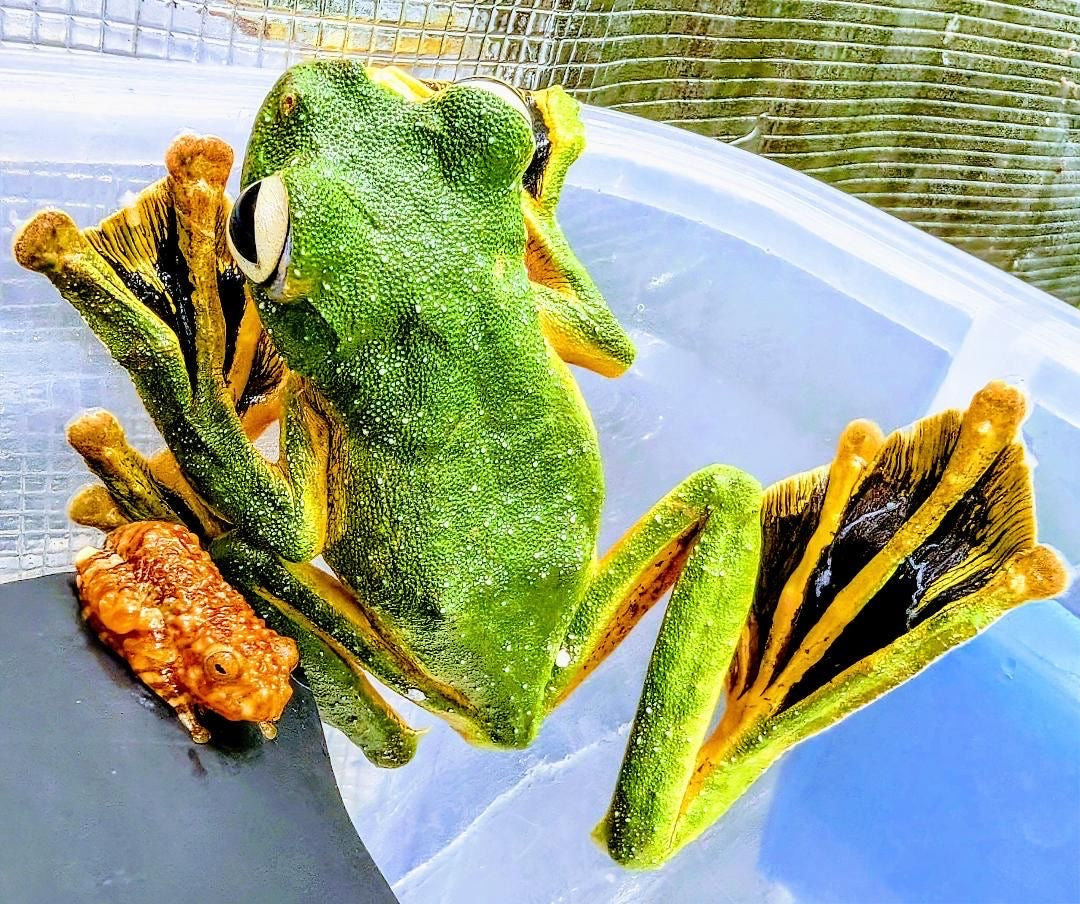
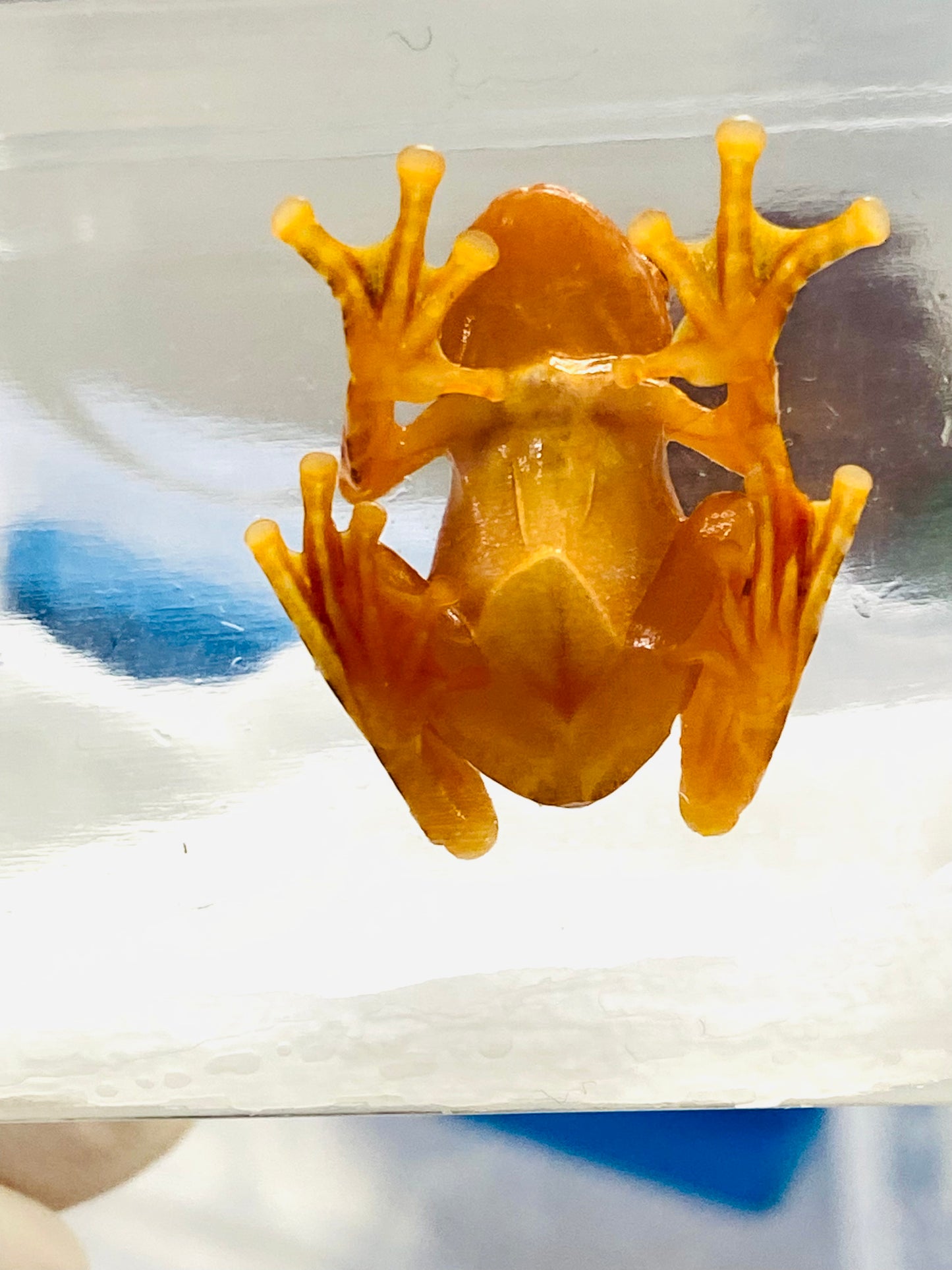
CB Wallaces Flying Froglets (Rhacophorus Nigropalmatus)
CB Wallaces Flying Froglets (Rhacophorus Nigropalmatus)
Couldn't load pickup availability
CB Wallaces Flying Froglets (Rhacophorus nigropalmatus)
Named after naturalist Alfred R. Wallace Adults get up to 10 cm long and females are noticeably larger than males . Their dorsal (top) surface is a vibrant, shiny green, while their undersides and inner thighs are bright yellow.Their defining feature is their extremely large hands and feet . The webbing between their toes is jet-black at the base and bright yellow toward the edges.
Originally from Peninsular Malaysia, Sumatra, and Borneo but these are CB in North America .
This is the rarer and larger species of flying/gliding frog compared to the more common but still rare Reinhardt flying frog which are smaller and often wild caught. Due to size and care need these are a mid to advanced keeper frog.
These are Captive-Bred and hence the higher price as WC frogs almost always do poorly and die shortly after culture and this is even more true of the flying frogs as wild animals rarely take crickets or other feeders.These are also an option for B.C. buyers looking for a legal large tree frog where most large tree frogs are restricted( banned in B.C.).
All specimens are juveniles and unsexed.
Care;
- Orientation: Choose a tall, vertically oriented glass enclosure.
- Dimensions: Minimum size of 18x18x24 inches for a single adult.
- Ventilation: Ensure strong cross-ventilation alongside high moisture retention.
- Safety: Use tightly secure screen lids to prevent forceful escapes.
- Temperature: Keep daytime temperatures between 75°F and 85°F (24°C–30°C).
- Night Drop: Drop night temperatures down to around 68°F–72°F.
- Humidity: Maintain a constant relative humidity level between 70% and 80%.
- Misting: Mist the tank 1–2 times daily using exclusively dechlorinated water.
- UVB Lighting: Provide a moderate 5% UVB light source to support natural activity.
- Photoperiod: Program a standard 12-hour day/night cycle.
- Substrate Base: Use a moisture-retaining blend of coconut husk, peat moss, and sphagnum moss.
- Drainage: Layer clay hydroballs underneath the substrate to prevent oversaturation.
- Primary Prey: Offer live, gut-loaded crickets, roaches, or silkworms.
- Variety: Supplement occasionally with hornworms or black soldier fly larvae.
- Dusting: Dust all insects with calcium plus D3 and multivitamins regularly.
- Frequency: Feed adult frogs 2–3 times a week, and juveniles every other day.
- Water Source: Keep a large, shallow bowl of clean, dechlorinated water at the base.
Share